
TRUTH, JUSTICE, & LIBERTY FOR ALL
FOUNDED IN 2023
Responsabilitas Singularis Abundantiam Societati Affert
APRIL 5, 2026

Elon Musk Tweets About Mars Robots, Forgets Investors Prefer Profits on This Planet
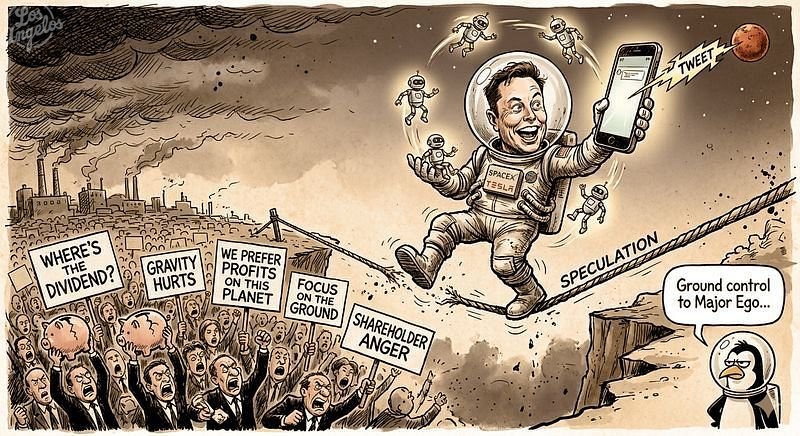
In a move that surprised exactly no one who's been paying attention, Elon Musk fired off a tweet late last week envisioning a Martian workforce of robots toiling away in the red planet's dust bowls. The post, which garnered millions of views and a fresh crop of memes, sent Tesla's stock tumbling 15% in a single day, wiping out billions in market value. Investors, those hardy souls who bet on electric cars and not interstellar fantasies, watched their portfolios evaporate faster than water on Mars.
The tweet in question, shared on X (formerly Twitter, formerly a fun place), painted a picture of Optimus robots, those humanoid helpers Tesla's been teasing, building colonies on the fourth rock from the sun. "Mars needs robots, not just humans," Musk wrote, or something to that effect, igniting a firestorm of debate over whether CEOs should stick to quarterly earnings or audition for sci-fi blockbusters. It's the kind of unfiltered musing that makes Musk a billionaire icon to some and a walking liability to others.
From Cybertrucks to Cosmic Distractions: A CEO's Side Quest
Musk's penchant for grand visions isn't new. Tesla, the company that put electric vehicles on the map, has long been a vehicle for Elon's bigger dreams: boring tunnels under cities, brain chips via Neuralink, and now robot overlords on another world. But while the tweet lit up social media with quips about "Elon colonizing his own timeline," Wall Street had a less amused reaction. Shares dipped as analysts scrambled to remind everyone that Tesla's core business is still cars, not cosmic real estate.
The timing couldn't have been worse. Tesla just reported a dip in profits, thanks to softening EV demand and price wars with competitors like BYD. Instead of a mea culpa or a pivot to, say, affordable sedans, Musk doubles down on the spectacle. It's like a chef announcing a moon base kitchen while his restaurant runs out of ingredients. Investors poured in expecting returns on batteries, not blueprints for Barsoom.
Critics were quick to pile on. "Elon's genius is in disruption, but disruption without delivery is just distraction," said Ross Gerber, a longtime Tesla investor and CEO of Gerber Kawasaki Wealth and Investment Management, in a CNBC interview shortly after the plunge. Gerber, who's trimmed his Tesla holdings amid the volatility, captured the growing frustration: a visionary leader whose tweets move markets more than milestones.
Shareholders Cry Foul, But Who Invited Them to the Party?
Of course, let's not pretend the investors are blameless snowflakes. These are the same folks who funneled trillions into Tesla at valuations that made it the world's most valuable carmaker, despite producing fewer vehicles than Ford. They cheered Musk's antics when stock soared on promises of full self-driving and robotaxis, turning every tweet into a bull run. Now, faced with a 15% haircut, they're clutching pearls over "labor ethics" in a hypothetical Mars economy?
The viral backlash leaned hard into the absurdity. Memes flooded X, showing Musk as a mad scientist abandoning Earth for robot utopia, captioned with lines like "Profits? We have Optimus for that." Labor advocates jumped in too, questioning the ethics of robot workers in any zip code. "If Musk thinks robots can replace humans on Mars, why not start with fair wages here?" tweeted United Auto Workers president Shawn Fain, highlighting the irony of a billionaire dodging earthly union talks while dreaming of automated frontiers.
It's a classic tale of mismatched expectations. Musk, ever the showman, treats Tesla like his personal canvas for humanity's future. Investors, meanwhile, showed up for the fireworks but bail when the check arrives. Warren Buffett, the Oracle of Omaha himself, once quipped about tech hype: "If you mix hype with substance, you get champagne. Substance without hype is just water. Hype without substance is just hot air." Tesla's been serving a fizzy cocktail, but this tweet popped the cork a bit too soon.
Financial pundits warn this could signal deeper woes. Tesla's market cap, still hovering around $700 billion post-drop, relies on the aura of innovation. But with rivals like Rivian and Lucid nipping at heels, and legacy automakers electrifying their lineups, Musk's distractions risk turning hype into history. As one anonymous hedge fund manager told Bloomberg, "We're funding Elon's hobbies, and it's starting to feel like a bad bet."
In the end, this Mars mishap underscores a timeless truth in business: visionaries build empires, but empires need profits to endure. Musk's tweet reminds us that while robots may conquer other worlds, back here on Earth, shareholders just want their cut before the spaceship leaves the launchpad. Isn't it convenient how the stars align for spectacle, even as the balance sheets dim?