
TRUTH, JUSTICE, & LIBERTY FOR ALL
FOUNDED IN 2023
Responsabilitas Singularis Abundantiam Societati Affert
APRIL 5, 2026

NCAA Players Caught Point-Shaving, Claim They Were 'Just Practicing for the NBA'
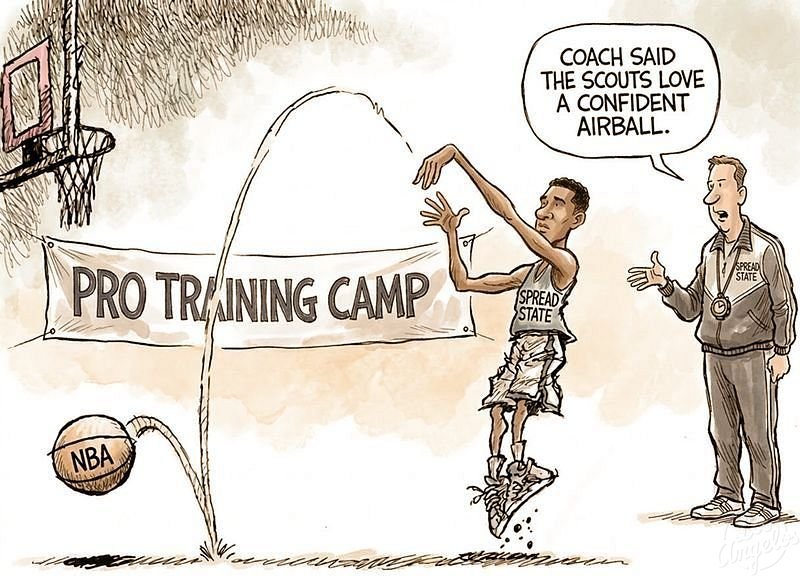
Federal prosecutors announced charges this week against 26 defendants connected to a sprawling college basketball gambling operation that allegedly manipulated the point spread in 29 NCAA games — a case authorities say represents the largest college basketball betting scandal since the infamous 1951 point-shaving scandal.
While investigators described the operation as a coordinated effort involving gamblers, intermediaries, and players, several athletes connected to the games have pushed back against the allegations, insisting their suspicious on-court performances were merely part of a long-term professional development plan.
"People keep calling it point-shaving," said one Division I guard who asked to remain anonymous. "But if you look at the modern NBA, what we're really doing is practicing strategic underperformance. You can't just start tanking overnight once you get drafted. These things take years to master."
Federal Investigation Meets Player Development
According to federal prosecutors, the scheme allegedly involved manipulating the margin of victory in dozens of games to influence sports betting outcomes. Rather than fixing who won or lost, players were accused of subtly missing shots, committing turnovers, or allowing late baskets to affect the final score relative to the betting line.
In several games cited by investigators, players reportedly missed multiple uncontested layups, dribbled the ball out of bounds without pressure, and launched jump shots that one analyst described as "less a basketball attempt and more a cry for help."
Still, some players argue the performances have been misinterpreted.
"Look, everyone knows NBA teams tank for draft picks," said another player linked to one of the games under investigation. "We're just getting ahead of the curve. Think of it like internships. Doctors have residency. Lawyers have clerkships. Future NBA players have to learn how to lose responsibly."
Industry Experts See Transferable Skills
Sports betting experts say point-shaving schemes typically rely on influencing a game's margin rather than the winner, making them difficult to detect without suspicious betting patterns.
But some basketball observers noted the players' unusually obvious mistakes may have unintentionally revealed a deeper issue: a generation of athletes preparing for a professional league where losing strategically can be just as valuable as winning.
"These kids may have overcorrected," said one anonymous NBA scout. "You want subtle mistakes. A missed rotation here, a lazy closeout there. Airballing a wide-open three while looking directly at the sportsbook line on your phone — that's rookie stuff."
Lessons From History
The investigation has drawn comparisons to the notorious 1951 point-shaving scandal, which rocked college basketball and led to dozens of arrests and multiple prison sentences.
Unlike that era, however, today's athletes operate in a sports world dominated by legalized betting, NIL sponsorships, and professional leagues where strategic losing has occasionally been treated as a long-term rebuilding strategy.
Several players implicated in the investigation reportedly defended their performances as a form of career preparation.
"If you can't convincingly miss a free throw in front of 20,000 people, how are you supposed to tank a full 82-game NBA season?" one player reportedly asked investigators.
Preparing for the Next Level
NCAA officials said the investigation remains ongoing and declined to comment on the players' explanation. Several universities involved have already suspended athletes pending the outcome of the federal case.
Still, some observers say the scandal may reveal an unexpected educational opportunity.
"College sports has always been about preparing athletes for the next level," said one athletics administrator. "In today's professional environment, that might include mastering advanced techniques like load management, controlled mediocrity, and the occasional strategically-timed airball."
Federal prosecutors emphasized that the charges involve serious allegations of fraud and gambling conspiracies. But if the accused players are correct, they may also represent the first generation of athletes accused of treating a federal investigation as nothing more than an unusually rigorous pre-draft training camp.